Best Aquarium Water Test Kits for Clear, Healthy Tanks
Regular water testing is essential for healthy aquariums. The right test kit helps detect invisible problems before fish show signs. This guide highlights five reliable aquarium water test kits and explains how to choose the best one for freshwater setups, including strips and liquid-test options. The focus is on accuracy, ease of use, and value, so you can maintain stable water conditions with confidence.
| Product | Brand | Highlights |
|---|---|---|
| API Freshwater Master Test Kit | API | 800 tests; tests pH, high range pH, ammonia, nitrite, nitrate; includes color card; 7 bottles |
| 11 in 1 Aquarium Test Strips | SJ WAVE | 11 parameters; quick home testing; color charts included |
| AAwipes 8-in-1 Aquarium Test Kit | AAwipes | 50 strips; 8 parameters; fast, accurate results; no color bleed |
| API GH & KH Test Kit | API | GH & KH measurements; 2 bottles, 2 tubes; freshwater focus |
| Umlecoa 7 in 1 Aquarium Test Kit | Umlecoa | 7 parameters; 125 strips; fast results; versatile for freshwater/saltwater |
The products below were chosen for broad parameter coverage, reliability, and ease of use. Each section provides a concise overview, a quick usage note, and key benefits to help readers compare options quickly.
API Freshwater Master Test Kit

The API Freshwater Master Test Kit is a comprehensive liquid-based system designed for freshwater aquariums. It includes seven bottles of testing solutions, one color card, and four tubes with caps, enabling testing of five vital water parameters: pH, high-range pH, ammonia, nitrite, and nitrate. With up to 800 tests in the kit, this option suits hobbyists who test regularly or manage larger tanks. Color-coded results aid interpretation, and the kit emphasizes early detection of water quality issues that can stress fish or plants.
Usage is straightforward: collect a water sample, follow the step-by-step instructions, compare colors to the card, and document results. The kit is well-suited for ongoing maintenance and for adjusting dosing or filtration when readings indicate drift. While it requires more liquids and steps than strips, its accuracy across multiple parameters makes it a strong choice for long-term monitoring in freshwater setups.
SJ WAVE 11-in-1 Aquarium Test Strips

SJ WAVE’s 11-in-1 test strips provide a broad snapshot of water quality with a single strip. They measure ammonia, pH, iron, chlorine, total hardness (GH), carbonate, nitrate, nitrite, total alkalinity, copper, and temperature, giving observers a quick, at-a-glance view of key parameters. The strips come with color charts for easy comparison and are suitable for both freshwater and saltwater tanks. This kit is lightweight and fast, making it convenient for frequent checks and instant corrective actions without trips to a store.
The strips are designed for home use with simple dipping and reading steps: dip the strip into water, compare against the chart, and record results. Sensitivity is tuned to detect low impurity levels, helping avert subtle water quality problems. Because color interpretation can vary by lighting, users should test under consistent lighting to improve accuracy and consistency over time.
AAwipes 8-in-1 Aquarium Test Kit
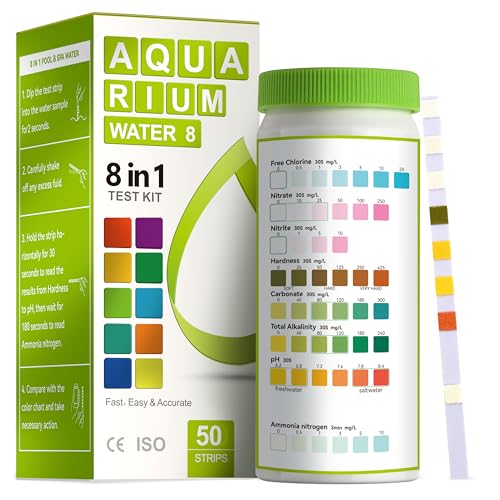
AAwipes offers an 8-in-1 test strip kit designed for versatility and speed. The kit includes 50 strips that assess Free Chlorine, Nitrate, Nitrite, Hardness, Carbonate, Total Alkalinity, pH, and Ammonia nitrogen. It emphasizes high-quality fiber paper with non-bleeding colors for clear results and is suitable for freshwater and ponds. The test steps are simple: dip, wait short intervals, and compare to a color chart. The kit targets rapid maintenance checks, making it practical for hobbyists who want reliable readings without complex procedures.
AAwipes notes compatibility with a range of aquarium environments, including ponds and shrimp tanks, and it recommends testing two times per week for optimal water quality. The 3-step procedure is designed to minimize user error, though lighting and color perception can influence interpretation. Regular use helps detect shifts early, enabling timely adjustments to filtration, dosing, or water changes.
API GH & KH Test Kit

The API GH & KH Test Kit focuses on general hardness (GH) and carbonate hardness (KH), two essential measures for buffering capacity and mineral balance in freshwater aquariums. The kit includes two bottles of testing solution and two test tubes with caps for efficient testing. Accurate GH and KH readings help prevent drift in pH and support stable biological processes in tanks with live plants or delicate species. This kit is a practical addition to routines when pH stability is a concern or when water sources show variable mineral content.
GH and KH testing complements pH checks by providing context: low KH can lead to sudden pH swings, while high GH values can influence mineral availability. Regular GH & KH monitoring supports proactive maintenance, especially after water changes, new stock introductions, or changes in filtration. While not a full parameter panel, the GH & KH kit is a focused, reliable tool for maintaining mineral balance in freshwater setups.
Umlecoa 7-in-1 Aquarium Test Kit

Umlecoa’s 7-in-1 kit tests seven important parameters in freshwater and saltwater environments using 125 strips with a test tube and thermometer. The 7 in 1 panel typically covers Nitrate (NO3), Nitrite (NO2), Chlorine (Cl2), Total Hardness (GH), Total Alkalinity (TA), Carbonate (KH), and pH. The kit emphasizes fast results with a straightforward 3-step process: dip, wait, and compare to a color chart. Its broad applicability makes it a convenient choice for aquariums with mixed species or for hobbyists who manage both freshwater and saltwater tanks.
Users should store strips in a cool, dry place and replace them when color charts or expiration dates indicate decline in accuracy. Because color interpretation can vary with lighting, it’s wise to test under consistent lighting conditions and maintain a routine to track changes over time. The Umlecoa kit offers a cost-effective way to monitor core water quality parameters in one compact package.
Buying Guide
Choosing the right aquarium water test kit depends on how you balance accuracy, convenience, and cost. The following considerations help clarify which option best fits your setup and routine.
Key Factors To Consider
- Parameter coverage: Do you need a broad panel (e.g., 11-in-1 strips) or a focused, precise measurement (GH/KH or pH-only)?
- Test type: Liquid-based master kits often offer high accuracy, while test strips provide speed and convenience for frequent checks.
- Freshwater vs Saltwater: Some kits are designed for freshwater, others for both, and a few cover saltwater needs more comprehensively.
- Ease of use: Consider number of steps, time to read results, and how clearly colors are distinguished under your lighting.
- Speed of results: If you react quickly to changing conditions, faster kits can help you act sooner.
- Cost per test: Initial kit price vs long-term cost per test matters for ongoing maintenance budgets.
- Accuracy and reliability: Look for kits with well-documented color charts and consistent results across tests.
- Storage and shelf life: Proper storage extends strip life and reagent effectiveness; check expiration dates.
- Brand support and availability: Reputable brands with readily available replacement parts simplify ongoing care.
- Maintenance routine: Decide how often you test (daily, weekly, or around water changes) and choose a kit that fits.
How To Read Test Results
For liquid kits, follow precise timing and color comparisons as instructed. With strips, ensure you compare colors within the recommended window and under consistent lighting. Record keeping helps detect trends and informs adjustments to filtration, dosing, or water changes.
Practical Scenarios
New tanks often experience pH and ammonia fluctuations; a multi-parameter kit helps monitor stability during cycle. Tanks with live plants may require careful KH management to avoid rapid pH shifts. Mixed-species or sensitive fish benefit from regular checks to prevent stress and disease caused by unseen imbalances.
Maintenance Frequency And Storage
For most freshwater setups, testing weekly is a good baseline, with more frequent checks after water changes, stock additions, or filter changes. Store test strips and reagents in a cool, dry place away from sunlight. Check expiration dates regularly to maintain accuracy and reliability in readings.