Best 5-Gallon Aquarium Heaters for Reliable Temperature Control
Maintaining a stable temperature is crucial for healthy fish in small aquariums. For tanks around five gallons, a compact heater with precise control helps reduce stress and disease by avoiding temperature swings. This guide highlights five reliable 25W–50W heaters suited for 1–6 gallon to 5–10 gallon setups, focusing on safety features, ease of use, and accurate temperature regulation. Each option is designed to fit discreetly in a small tank while delivering dependable warmth for tropical fish, bettas, or mixed freshwater habitats.
| Product | Brand | Tank Range (Gallons) | Key Feature |
|---|---|---|---|
| Orlushy 25W Submersible Heater | Orlushy | 1–6 | Automatic 78°F with ±3°F accuracy; compact 4.7″ design |
| Tetra HT Submersible Heater (50W) | Tetra | 2–10 | Indicator lights; automatic 78°F; short-circuit safety shutoff |
| hygger Mini 50W Submersible Heater | hygger | 5–10 | External digital controller; beeps for faults; overload protection |
| DaToo Mini 25W Aquarium Heater | DaToo | 1–5 | Preset 78°F; red/green indicator lights; ultra-compact |
| PULACO 25W Submersible Betta Heater | PULACO | 1–6 | Free thermometer strip; 78°F target; reliable accuracy |
Orlushy 25W Submersible Heater (1-6 Gal)

This Orlushy model is designed for small tanks from 1 to 6 gallons and measures about 4.7 inches long, making it easy to hide in compact setups. It operates with automatic constant temperature control as soon as power is on. The preset target is 78°F, with an accuracy of ±3°F. A red indicator signals active heating, while green indicates the target temperature has been reached. The heater uses a durable outer shell of heat-resistant ABS and a nickel-chromium heating wire inside a quartz glass body for safety and longevity.
Installation requires full submersion and vertical placement in the water for accurate sensing. The device is compact enough for low water levels and small hides within the tank decor. It is suitable for both freshwater and saltwater environments, though placement and monitoring remain essential to prevent overheating. Overall, it provides a balance of simplicity and reliable temperature control in mini ecosystems.
Tetra HT Submersible Heater (50W)

The Tetra HT heater uses an integrated electronic thermostat to maintain a stable 78°F in aquariums sized from 2 to 10 gallons. It features indicator lights that show heating status—red when active and green when the target temperature is reached. A safety feature automatically shuts off the heater if an electrical short is detected, protecting both the tank inhabitants and the wiring. The unit requires no user adjustment, simplifying setup for beginner and busy hobbyists alike. It is especially compatible with tanks that have hoods or glass canopies, reducing heat loss and improving efficiency.
Users should ensure the heater is fully submerged and placed away from filtration intakes to prevent uneven heating. While the device is versatile, larger tanks near the upper end of the range may benefit from pairing with a secondary heater for redundancy in case of malfunction. The HT model provides dependable temperature maintenance with minimal maintenance.
Hygger Mini 50W Submersible Heater (5-10 Gal)

The hygger mini heater focuses on compact design with a 4-inch heating element that fits neatly into 5–10 gallon tanks. It includes an external thermostat controller with a digital display for real-time temperature readings and easy adjustments. The unit offers a beeping alarm and fault prompts to indicate issues such as low water or overheating, helping owners respond quickly. Built-in safety features include low-water shutoff and overheating protection, reducing risk to fish and other aquatic life while providing clear visual indicators of heating status.
In use, the heater should be installed vertically or horizontally per the tank layout, ensuring full submersion. The temperature range on the external controller covers typical tropical ranges, and the device is designed to be robust in both freshwater and saltwater environments. Regular checks ensure the digital display remains accurate and the beeps remain audible if a fault occurs.
DaToo Mini 25W Aquarium Heater (1-5 Gal)
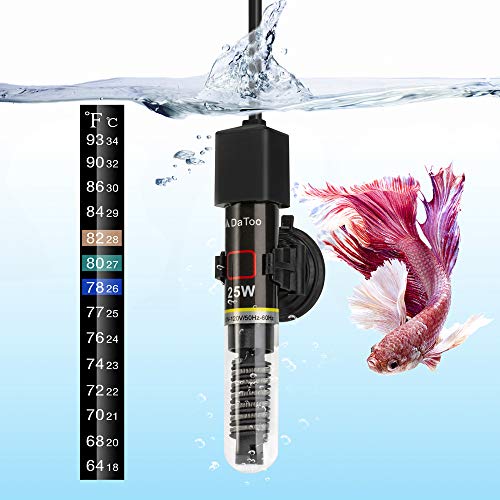
The DaToo 25W heater is designed for small tanks from 1 to 5 gallons and is noted for its compact form, explaining its claim as the smallest 25W heater on the market. It maintains a consistent temperature by automatically heating to a target around 78°F and signaling status with red and green indicator lights. When heating, the red light is on; once the target is reached, the green light appears. This design aims to maximize space in tiny setups while providing reliable temperature control for bettas and many tropical species.
As with other compact heaters, placement is critical. The heater should be fully submerged and oriented to deliver even heat without being blocked by decor. The device prioritizes ease of use and predictable performance in small-volume aquariums, though owners should monitor for any drift in temperature in particularly variable environments.
PULACO 25W Submersible Betta Heater (1-6 Gal)
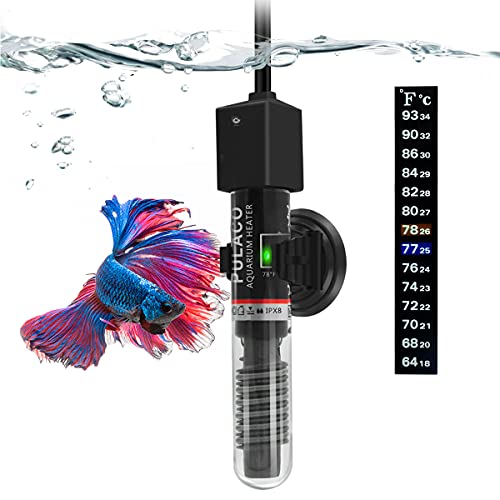
PULACO’s 25W heater is designed for 1–6 gallon tanks and ships with a free thermometer strip for quick temperature tracking. It requires full submersion and supports vertical or horizontal placement. The device targets a constant 78°F with an accuracy of ±3°F, and it uses red and green indicator lights to signal heating or stabilization. This model emphasizes simplicity and reliability in small habitats, especially betta and other small tropical setups where space is at a premium.
Practical use notes include ensuring the heater is away from direct water movement to prevent uneven heating and avoiding placement near the tank rim where temperature readings might be skewed. Regular inspection of the thermometer strip and sensor helps maintain consistent conditions across changing seasons or room temperatures.
Buying Guide
Key purchase considerations
Tank size and wattage alignment is essential. Small tanks under 5 gallons typically do well with 25W heaters, while slightly larger 5–10 gallon setups may benefit from 50W options with more robust temperature control. Avoid over- or under-heating by matching heater output to the tank’s capacity and volume fluctuations due to lighting, feeding, or room temperature swings.
Temperature control and accuracy
Look for a built-in thermostat with a precise setpoint and clear indicators for heating and target temperature. A variation range of ±1–3°F is common in quality units and helps maintain stable conditions for sensitive species. External digital controllers provide real-time readings and easier adjustments, particularly in busy home aquariums.
Safety features
Important safety features include automatic shutoff at low water levels, dry-run protection, and overheat protection. These reduce the risk of heater damage and protect fish from sudden temperature spikes. Heaters with robust housings (quartz glass or heat-resistant shells) and corrosion-resistant components also enhance long-term safety in freshwater and saltwater tanks.
Installation and visibility
Compact designs fit into cluttered shelves or decorative setups. Submersion orientation matters: some models perform better when placed vertically, others horizontally. Heaters with external controllers or digital displays are especially convenient for quick temperature checks. Consider the tank lid and access for cable routing to minimize heat loss and maintain a tidy appearance.
Durability and materials
Materials such as quartz glass and nickel-chromium elements offer better heat resistance and longer life. ABS housings provide impact resistance, while cutouts and seals should prevent water ingress. Heaters designed for both freshwater and saltwater environments tend to have longer lifespans due to corrosion-resistant components.
Maintenance and monitoring
Regularly inspect for signs of wear, check indicator lights, and verify temperature readings with a trusted thermometer. In tanks with fluctuating room temperatures, periodic recalibration may be needed. If a heater displays error codes or fails to maintain the target temperature, consider replacement or using a dual-heater setup for redundancy.